How Wildfire Smoke Can Impact Indoor Air Quality in El Paso County Homes
Quick Answer: Wildfire smoke carries fine particulate matter small enough to slip past window seals, door gaps, and standard HVAC filters, so it builds up inside your home even with everything shut. The fix isn't one thing. It's a combination of upgrading your filter to the highest MERV rating your system can safely handle, running your blower fan continuously instead of on "auto," closing off any outdoor air intake, and adding portable or whole-house HEPA-grade filtration during the worst smoke days.
You know the feeling. The sky over Peyton turns that flat orange-gray, you can smell it before you see it, and by evening your throat feels dry even though you haven't stepped outside. That's not your imagination. Smoke from wildfires burning in the foothills, across the Front Range, or drifting in from fires hundreds of miles away settles into El Paso County more than most people realize, and a fair amount of it ends up inside your house whether you notice or not.
Why Smoke Gets In Even When Everything's Closed
Your house isn't sealed like a submarine, and it was never built to be. Every home has small gaps around window frames, door thresholds, electrical penetrations, and where the foundation meets the framing. Under normal conditions those gaps don't matter much. During a smoke event, they're an open door.
Here's what makes it worse. Running a bathroom exhaust fan, a range hood, or a clothes dryer pulls air out of your house, and that air has to come from somewhere. It gets replaced through those same small gaps, dragging outdoor smoke in right along with it. Older homes scattered around Falcon and Black Forest, many built before current energy codes tightened up construction standards, tend to have more of these gaps than newer builds closer to Colorado Springs proper. And if your HVAC system has a fresh-air intake or an economizer that pulls in outdoor air on purpose, that's an even more direct path for smoke to reach your supply ducts.
Elevation plays a role too, though not in the way most people expect. Smoke from distant wildfires often travels at altitude before settling, and El Paso County sits high enough that plumes crossing the Front Range can drop right into the valley instead of staying up and away. Some of the worst smoke days here come from fires burning nowhere near Peyton at all.
The Particle Size Problem Nobody Can See
Ash and soot you can see and clean up easily enough. It's heavier, it settles on your patio furniture and windshield, and a garden hose takes care of most of it. The real problem is the stuff you can't see.
Wildfire smoke is loaded with PM2.5, particulate matter 2.5 microns or smaller. To put that in perspective, a single human hair runs about 70 microns wide, so you're talking about particles roughly a thirtieth that size. Particles this small don't settle out of the air the way dust does. They stay suspended, drift with whatever airflow is happening in the room, and pass straight through a basic fiberglass filter — the thin blue kind most furnaces ship with — almost as if it wasn't there. Those filters were designed to protect your blower motor from lint and large debris, not to stop combustion particulate.
This matters because a house that looks clean and smells fine can still have elevated fine-particulate levels circulating through it. You won't necessarily notice a haze indoors. The particles are simply too small to see against normal light.
Tip: Pull your current furnace filter out and check the cardboard or plastic frame edge — most filters print a MERV number right there. If you don't see one, or the packaging just says "standard" or "economy," assume it's in the MERV 1–4 range and plan to upgrade before smoke season hits its peak, typically June through September here.
What Your Filter Slot Can Actually Handle
MERV stands for Minimum Efficiency Reporting Value, and it's the industry scale for how well a filter captures particles of different sizes. The higher the number, the finer the particulate it traps — and the tighter that mesh gets. Filtration guidance from EPA and ASHRAE points to MERV 13 as the practical target for wildfire smoke, since that rating captures a meaningful share of PM2.5-range particulate that lower-rated filters just don't touch.
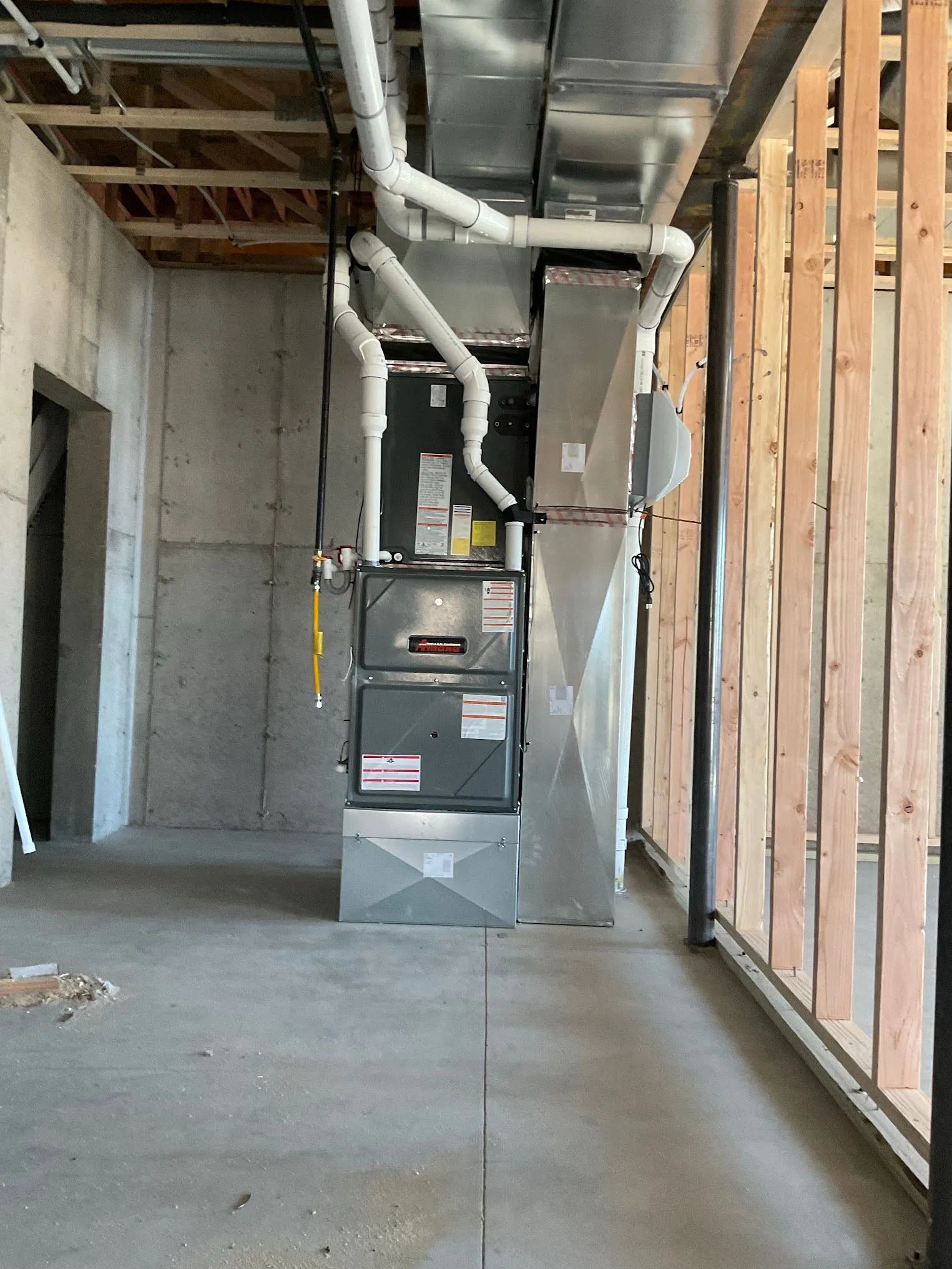
But you can't always drop a MERV 13 filter into whatever slot your system already has and call it done. Denser filter media restricts airflow more than a thin, low-efficiency filter does, and older or undersized blower motors weren't engineered to pull air through that extra resistance. Push too much static pressure on a system that isn't built for it, and you risk reduced airflow, a coil that can ice up in cooling mode, or a blower that runs hotter and wears out faster than it should. This is exactly the kind of compatibility check a technician runs before recommending a filter upgrade — measuring your system's static pressure and confirming what it can actually take before bumping the rating.
Sealing the House Up and Managing Air Exchange
Once you know smoke is settling in, the next move is limiting how much outside air gets pulled in at all. If your HVAC system has a fresh-air intake or damper, close it during smoke events. Set your thermostat fan switch to "On" instead of "Auto" so the blower keeps circulating air — and pushing it through the filter — even between heating or cooling cycles, rather than sitting idle. And go easy on exhaust fans. A five-minute shower fan run is fine; leaving the range hood on high for an hour while you cook draws in more outdoor air than most people realize.
Homes still running evaporative coolers face a bigger challenge here. Swamp coolers work by pulling large volumes of outside air across a wet pad and pushing it into the house — that's the entire point of the system, and it's a great match for El Paso County's dry summer heat most of the year. During a smoke event, that same design becomes a liability, because the cooler is pulling smoke-laden outdoor air directly inside with essentially no filtration in the path.
Warning: If your home relies on an evaporative cooler, don't run it during heavy smoke without a plan. Some units have a recirculate or bypass mode — check your owner's manual or ask a technician to confirm whether yours does. If it doesn't, shut the cooler off and switch to air conditioning or fans for the duration of the smoke event, since running a standard swamp cooler is one of the fastest ways to pull outdoor particulate straight into your living space.
HEPA and Media Filtration Beyond the Standard Slot
A single 1-inch filter, even a high-MERV one, has limits on how much surface area it can offer before it starts choking airflow. Two other approaches close that gap.
Portable HEPA air cleaners handle one room at a time. A true HEPA filter captures 99.97% of particles down to 0.3 microns, which covers the PM2.5 range with room to spare. Sizing matters here — a unit rated for a 200-square-foot bedroom won't do much in a 500-square-foot great room, so match the cleaner's coverage rating to the actual space you're trying to protect, and run it continuously on the highest setting you can tolerate for noise during the worst smoke days.
Whole-house media air cleaners take a different route. Instead of a thin filter jammed into your existing slot, these install a deeper cabinet — often four to five inches — directly into your ductwork, giving the filter media far more surface area to work with. More surface area means the system can hit MERV 13-equivalent filtration without the airflow penalty a thin high-MERV filter would cause squeezed into a standard 1-inch slot. For a home where smoke is a recurring seasonal problem rather than a once-a-summer event, that's usually the more durable fix.
Building a Smoke-Season Routine Before You Need One
Waiting until the sky turns orange to figure out your filter rating or find your fresh-air damper is the wrong time to learn your system. Walk through it now, while the air's still clear. Know where your outdoor air intake is and how to close it. Know how to switch your thermostat fan between "auto" and "on." Keep a spare high-MERV filter on hand instead of waiting on a supply run once every hardware store in Colorado Springs has sold out.
During an active smoke event, plan to change filters more often than the box recommends. A filter loaded with fine particulate loses efficiency fast, and a visibly gray or soiled filter is also restricting airflow through your system — sometimes enough to trip a limit switch or short-cycle the blower. Checking regional air quality reports before deciding whether to run errands or leave windows cracked for a load of laundry is a habit worth building into your routine every summer, not just during a bad fire year.
One more thing worth saying plainly: none of this is medical guidance. If you or someone in your household has asthma, COPD, or another condition affected by air quality, that conversation belongs with a physician, not an HVAC technician. What a heating and cooling system can do is control what's circulating through your ductwork and living space — the mechanical side of the problem.
Frequently Asked Questions
Does keeping my windows and doors shut fully protect me from wildfire smoke?
No. Closed windows and doors reduce smoke entry but cannot eliminate it. Fine particles can enter through small gaps, making filtration and proper air-exchange management equally important.
Can I just run my air conditioner and let it handle the smoke?
Only with effective filtration and a closed fresh-air intake. Your air conditioner circulates indoor air, while the HVAC filter captures smoke particles. Basic filters offer limited protection.
How do I find out what MERV rating my current filter has?
Check the filter's cardboard or plastic frame for a printed MERV rating. If none appears, assume efficiency is low and confirm your system's capabilities before upgrading.
Is a portable air purifier enough, or do I need a whole-house solution?
A properly sized portable HEPA purifier can protect one room during temporary smoke events. Whole-house filtration provides broader coverage and makes more sense when wildfire smoke recurs regularly.
How often should I change my HVAC filter during a wildfire smoke event?
Check your filter every couple of weeks during heavy smoke. Fine particles can load filters quickly, restricting airflow. Replace it sooner whenever the filter appears noticeably gray or dirty.
A Clearer Indoor Air Strategy During Wildfire Season
For homeowners across Peyton, Colorado, and the surrounding El Paso County region, wildfire smoke can turn indoor air quality into a seasonal concern. Gold Star Heating and Air, with 20 years of experience, understands how filtration, airflow, and outdoor-air management work together when smoke settles over the area. A properly matched filter, controlled ventilation, and consistent air circulation can reduce the amount of fine particulate moving through living spaces while helping the HVAC system operate within its intended limits.
The goal is not to make a home completely isolated from outdoor conditions, because normal homes still exchange some air with the outside. Instead, effective smoke-season preparation focuses on reducing unnecessary outdoor-air entry and improving the system's ability to capture particles that make their way indoors. With the right combination of filtration and airflow practices, homeowners can maintain a cleaner, more controlled indoor environment even when wildfire smoke affects El Paso County.